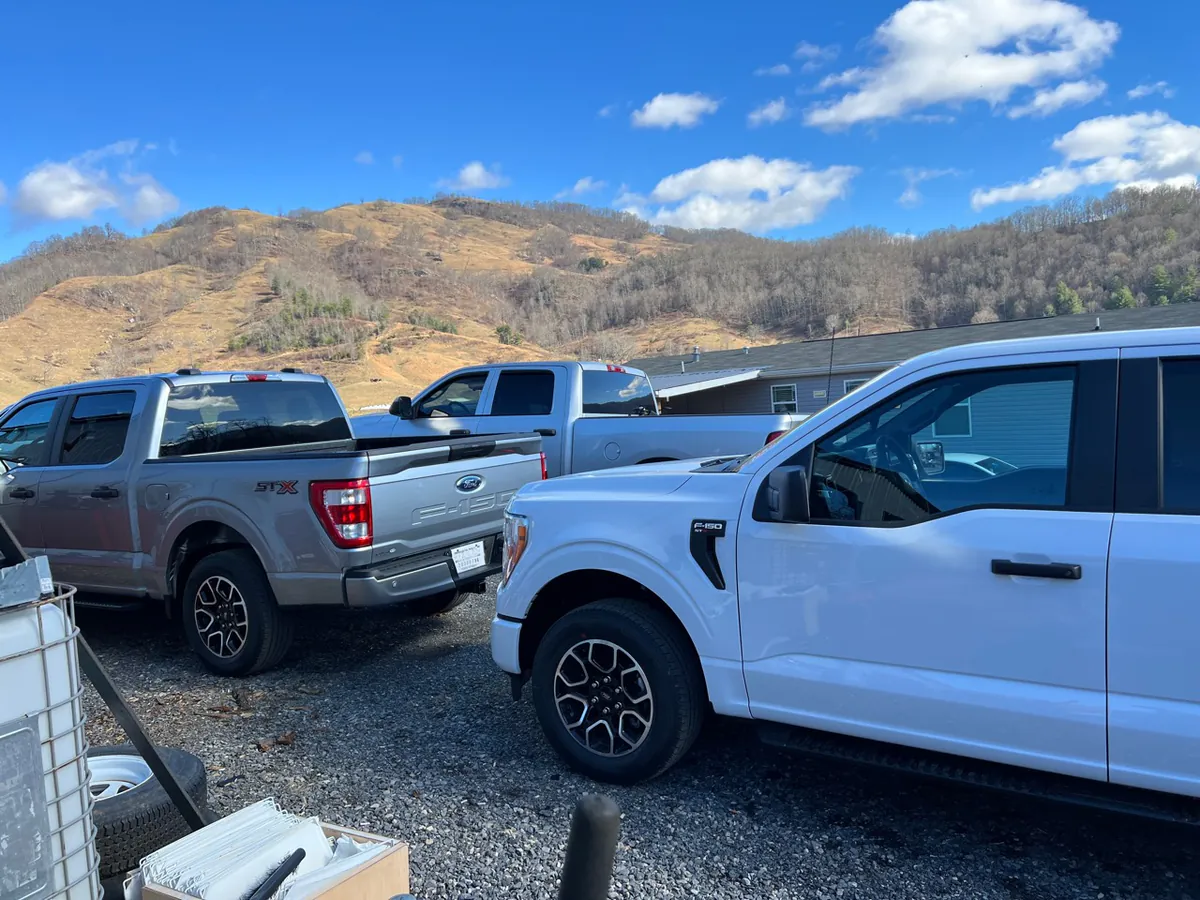
Editor's note: WNC Life is owned by Sinteag Ventures, Inc., the company that developed Headroom. Sinteag founder Skip Middleton is the subject of this story.
If you were here in the fall of 2024, you remember what the power company's map looked like after Hurricane Helene: almost all red. You remember the hum of generators up and down the road, the gas cans lined up by the porch, and the math everybody did every evening. How much fuel is left? What can we run tonight — the freezer, the well pump, or the space heater? Not all three.


That nightly math is the whole idea behind Headroom, a piece of software being built in Clyde by Skip Middleton, founder of Sinteag Ventures and a member of Haywood Electric Membership Corporation (Haywood EMC). It does the same arithmetic, just for businesses and the sites that power them instead of households — and it shows its work.
Middleton knows that arithmetic firsthand. Through Helene, as in hurricanes before it, he kept a running count: the house's daily power draw, propane burning at about 1.6 gallons an hour, and the fuel left in the tank — all to estimate how long the household could hold out. Headroom grew out of the same habit: don't guess what you have left; measure it against what's already spoken for.

Think of it like a title search
Anybody who has bought land in Haywood County knows the drill. Before you close, a title search tells you what's on record, what's already owed against the property and what's still in question. Nobody sensible buys a tract on a handshake and a hunch.
Middleton calls Headroom "a title search for power." Point it at a site — a factory, a hospital campus, a charging station with a battery bank and a backup generator — and it reads that site's own records. It sets aside everything that's already spoken for: the load already running, the backup the building has to keep in reserve, the fuel that must stay in the tank. Then it reports what's left, what's limiting it, and what evidence is missing.
Two rules have been there from the start. First, when the records are thin, stale or don't agree with each other, Headroom counts less available power, not more. It doesn't guess to fill the gaps. Second, it only reads. It never flips a switch or touches equipment.
What a "no" looks like
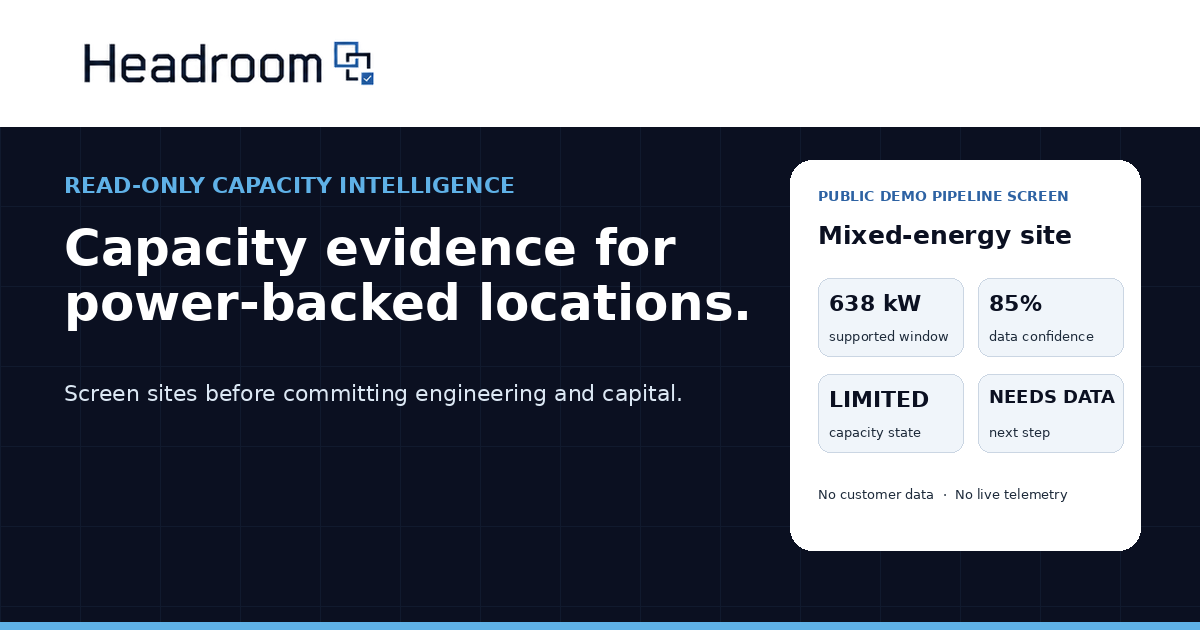
The example on the company's website, built on a made-up test site, shows the style. Someone asks: can this site take on another 400 kilowatts (kW) — roughly the average draw of a few hundred homes at once — for three hours?
Headroom says no, and says why. To cover it, the generator would have to put out 550 kW. The records only prove it can do 500. It flags fuel reserve problems too. And here's the part Middleton is proudest of: it won't tell you a slightly smaller request would work, because nobody has checked that. No rounding up. No benefit of the doubt.
Joe Friday for electricity
Middleton's own shorthand for the software is Sergeant Joe Friday — the flat-voiced Dragnet detective who only wanted the facts. As long as he's the one building and running it, he says, Headroom won't puff up available capacity to help a developer get a project approved, and it won't downplay what anyone is pulling off the system, whether that's a big plant or a single household.
Why does a referee matter? Because the questions are getting bigger. Data centers, truck-charging hubs and new factories are all looking for places to plug in, and every power system has to ask the same thing before it says yes: can we carry this new customer without shortchanging the people already on the line? In North Carolina, that question lands on the electric cooperatives as much as anyone — co-ops serve members in 93 of the state's 100 counties.
Texas learned what it costs to get that math wrong. During Winter Storm Uri in February 2021, every kind of power plant had failures, and demand ran about 14 percent above the grid operator's most extreme winter forecast, according to a University of Texas at Austin study. More than 4.5 million Texas homes and businesses lost power. In June 2025, Texas passed Senate Bill 6, which lets its grid operator order very large users — 75 megawatts and up — to switch to backup power or cut back during an emergency.
A rule like that raises an obvious follow-up: when the order went out, did those big users actually come off the grid? Middleton's longer-range goal is independent, repeatable reporting that co-ops, counties and ordinary people could rely on to answer questions like that, with the evidence laid out so anyone can check it. Planning the grid itself would stay the utility's job.
How it got started
It started with a headline. In June 2026, Middleton read about a Tesla trademark filing for something called a "Megapod," described as modular computing hardware for artificial intelligence (AI). The writer ran with it, picturing the units parked at quiet electric vehicle chargers, soaking up power the cars weren't using. The Tesla filing itself didn't go where the writer did, but the idea behind it stuck.
Expensive electrical gear often has spare capacity that's real but not always there when you need it. Before anybody sells, borrows or builds on that spare capacity, somebody needs to prove how much of it is actually dependable. Within a week he'd filed a provisional patent application. Headroom is now patent pending.
Where it stands — plainly
Headroom is fully functioning software, not a slide deck. Middleton first approached Haywood EMC about using co-op data to help build it out; when that didn't come together, he went elsewhere, and the software has been built and tested on public energy data run against simulated site conditions. Conversations are underway with power and data-center companies — including operators with sites in multiple states — and with investor groups weighing potential investments in power and compute. In every case, Headroom's job is the same: a check on how much new load a site can honestly take on. Middleton built it to work at any scale, from national utilities and regional co-ops to towns and small businesses running a handful of electric vehicle chargers. An independent engineering review is next, along with heat, cooling and compute loads.
Made in Haywood County
Middleton started Sinteag Ventures in 2006 while he was still running Inbox.com day to day. He stayed until December 2014. His career has taken him through corporate strategy, company turnarounds and boardrooms across the United States, Europe, Japan and Australia, and he still serves on corporate boards today as a non-executive director. Over the years, Sinteag has grown into a portfolio of investments, many of them started right here in Haywood County — Headroom among them. All of them have been bootstrapped by Middleton and his wife, Christa, with no outside investors. Sinteag uses a development team based in the Southeast and Europe for some of its other holdings in energy and elsewhere.
What came out of Clyde is the step that has to come before anyone sells, borrows or builds on spare power: an honest count of how much can really be relied on, written down so anyone can check it. In a county that spent weeks doing that math by flashlight, that's not an abstract idea.
Learn more about Headroom at headroomiq.com and about Sinteag Ventures at sinteag.com. Headroom is not affiliated with Tesla.
Photography courtesy of the Middleton family.
Sources
- University of Texas at Austin Energy Institute, The Timeline and Events of the February 2021 Texas Electric Grid Blackouts (July 2021)
- Texas Senate Bill 6, 89th Legislature (signed June 2025)
- Carolina Country, "About N.C. Co-ops"
- Not a Tesla App, Tesla Megapod trademark article (June 26, 2026)
- headroomiq.com, public example report