WNC LifeWildlife

One rufous hummingbird, Alabama to Alaska in 38 days

An adult male rufous we call Magellan spent the winter on the Gulf Coast. In spring 2025 he carried a solar tag lighter than a paper clip 4,055 miles to Juneau, and 1,015 detections from strangers’ phones recorded the trip. It is the longest hummingbird migration ever tracked, and the route is stranger than the distance.

Based on Rhodes et al., “Ultralight Solar Transmitter Enables Fine-Scale Movement Ecology in North American Hummingbird Migration,” Ecology and Evolution, published 16 November 2026 (open access).

His track, from the detection dataSilent stretches, no receivers in range The 2,939-mile straight line he didn't take
4,055 miflown, adding up every leg between detections
2,939 mirelease point to last detection, straight line
38 days27 March to 3 May 2025, as reported
0.06 gthe tag, 1.6% of his 3.8 g body weight
23,784detections from 11 tagged birds

The trip, stop by stop

Read straight from his detection log; numbers match the map. Dates are as recorded, in Universal Time, so an evening detection can carry the next day’s date.

    He went 1,100 miles out of his way, and that is the interesting part

    Juneau sits northwest of Mobile Bay. A bird in a hurry would angle across the Plains and the Rockies. Magellan didn’t. From a backyard feeder in Lillian, Alabama, he flew due west across Louisiana and Texas, slipped into Sonora, reached the Pacific at San Diego, and only then turned north, hugging the coast through California, Oregon and British Columbia to Juneau.

    That second leg is the classic rufous spring road: the Pacific flyway, where early blooms run up California ahead of the season and the birds reach southern Alaska in May. A bird that wintered on the Gulf Coast didn't invent a shortcut. He crossed the continent to get onto the highway the western population already uses, and rode it home. The researchers presume he was breeding at Juneau, near the northern edge of the species' breeding range.

    The detour is easy to price: 4,055 miles flown against 2,939 as the crow flies, roughly 38% extra, on a body that weighs less than a nickel.

    Adding up the straight lines between his 1,015 published detections gives 4,051 miles, within a few miles of the paper’s 4,055. His first and last detections are about 37 days apart; the paper describes it as a 38-day period. Why he chose this route is not something the data can answer.

    ≈85 million

    body lengths, taking a rufous as about 3 inches long. A Boeing 747 matching that ratio would fly about 3.7 million miles, nearly eight round trips to the Moon.

    Pace, in plain terms

    About 107 miles a day averaged over the whole trip, rest days included. His travel days were far bigger. On 1 April he left Lillian in the morning and was detected near Ville Platte, Louisiana, about 286 miles west, by early evening. On 20 April he covered about 270 miles of Northern California.

    Where the phones are

    In two days at Odessa, Texas, he was picked up 191 times. Then came three days of silence over the desert, one ping in Sonora, and nothing again until San Diego. The gaps on the map are not rest stops. They are places where nobody’s phone was close enough to hear him.

    Where Gulf Coast rufous come from

    Rufous hummingbirds wintering in Alabama and Florida were long dismissed as strays. Banders, Fred Bassett foremost, spent decades proving they are a regular winter population. Where those birds went in spring was mostly inference. Magellan is the first one followed all the way.

    A longer track, not a longer straight line

    The record Magellan beat belonged to a female rufous banded in Tallahassee on 13 January 2010 and caught again on 28 June 2010, breeding at Chenega Bay, Alaska. The distance between those two points is about 3,500 miles.

    Read the fine print and the comparison is apples to oranges. Her 3,500 miles is a straight line between a band and a recapture. She certainly flew farther, but nobody knows how much farther. Magellan's 4,055 miles is the first measured, leg-by-leg track. As the crow flies, his trip (2,939 miles) is actually shorter than hers.

    The real record is the evidence, not the mileage. Leg bands only tell you where a bird started and where someone happened to catch it again. Everything between is a blank, and recaptures are rare.

    13long-distance (“foreign”) recaptures in 21 years of Gulf Coast hummingbird banding, 1999–2020
    23,784detections from 11 tags in a single season

    The other ten birds did not follow the script either

    The team tagged 11 birds (4 rufous, 7 ruby-throated) at seven backyard feeders in coastal Alabama and the Florida Panhandle in March and April 2025, all long-time banding sites. Every bird was detected after release, 9 of them more than 6 miles away and 8 more than 60 miles away, across 23 states, Sonora and British Columbia.

    Capture sitesEach bird’s detected trackPins mark last detections and match the table

    BirdSpecies, sexWhat it did

    Nicknames are ours; the researchers use band numbers only. Dates are 2025. Clark's last detection is dated 17 May in the paper's table and 13 May in its text.

    How a tag with no GPS and no battery follows a bird across a continent
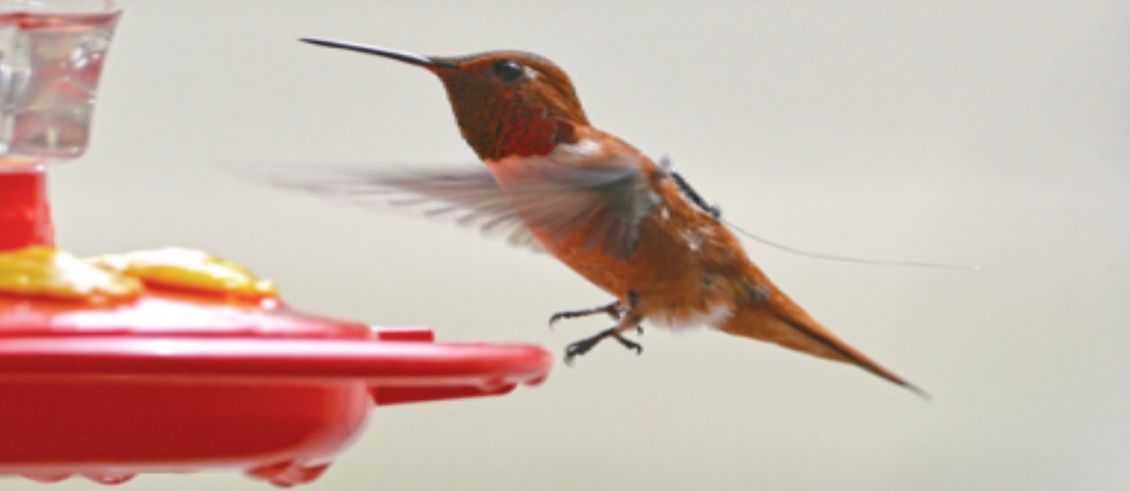
    A rufous hummingbird hovering at a red feeder with a small solar tag on its back and a thin antenna trailing toward its tail
    A tagged rufous at a feeder, antenna trailing along the tail.

    Photos: © 2026 Rhodes et al., Ecology and Evolution, Supporting Information Figure S1, used under a Creative Commons Attribution License. Cropped.

    The BlūMorpho, made by Cellular Tracking Technologies in Rio Grande, New Jersey, has no battery and stores nothing. Whenever light hits its panel, it broadcasts a coded ID on 2.4 GHz every three seconds and lets the world listen.

    For scale: the only earlier tracking study on hummingbirds this small, in 2018, used radio tags of 0.28 g, almost five times heavier and about 6.9% of the bird's weight. Their batteries lasted about ten days, and most birds were heard only within about 7 miles of the coast. This study held every tag to 3% of body weight or less.
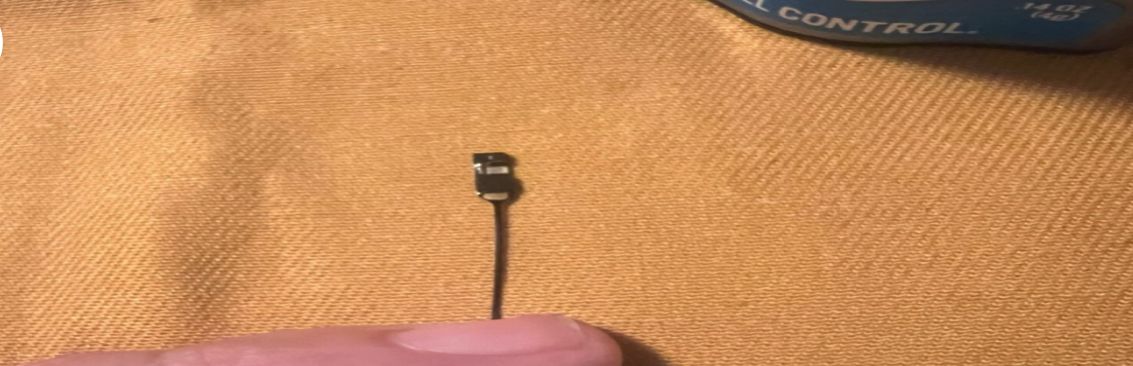
    The BlūMorpho tag, a tiny black square with a wire antenna, balanced on a fingertip
    The whole tag, on a fingertip.
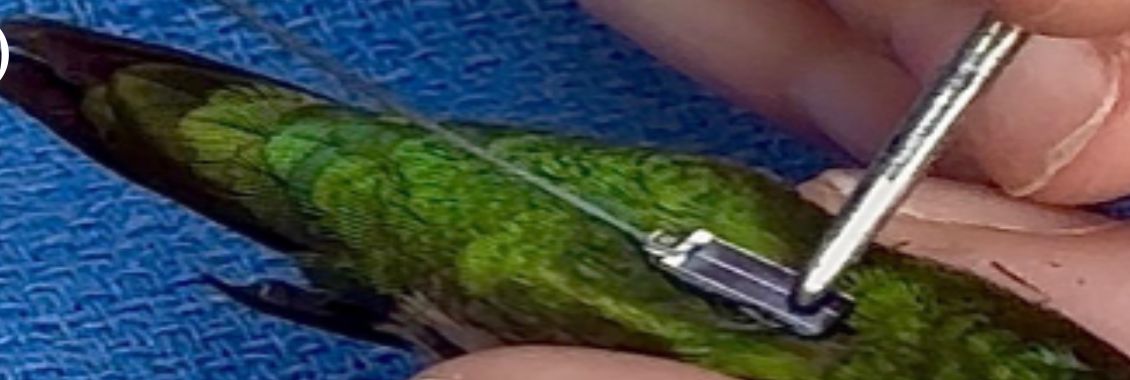
    A tag being pressed onto a ruby-throated hummingbird's back with the end of a metal knitting needle
    Held with a knitting needle while the glue sets.
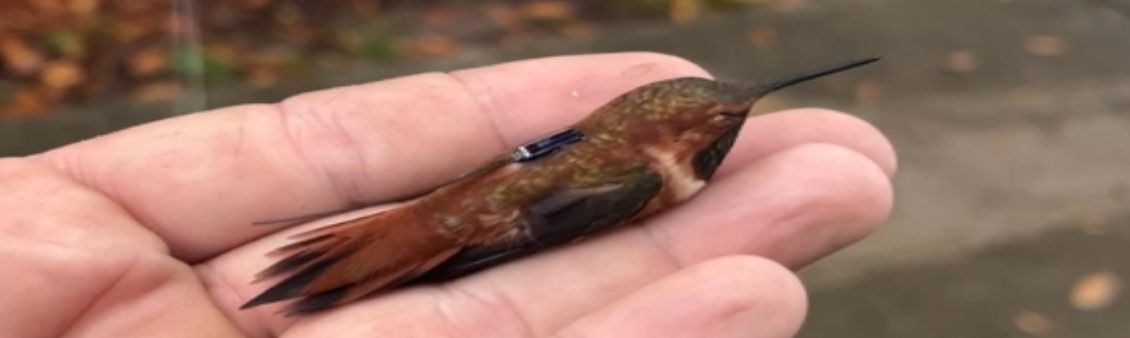
    A tagged rufous hummingbird resting on an open palm before release
    Ready to go.

    Attach

    No harness. With the bird's head covered by a light cloth, a patch of back feathers about ⅛ × ⅜ inch is trimmed, and the tag is glued on with gel super glue or eyelash adhesive and held with a knitting needle for about 30 seconds. A pinch of baking soda speeds the cure.

    Release

    Some birds sat with eyes closed for up to a minute before leaving. All of them flew off.

    Overhear

    Most modern phones, tablets and computers with Bluetooth and location on pick up the signal anonymously within about 650 feet, as do handheld receivers, tracking towers and a community receiver network.

    Map

    New detections are collected every five minutes, so tracks build in near real time. Tags kept reporting for 47 days on average (3 to 128) before preening, weather or molt knocked them off.

    Why this matters to anyone with a feeder

    Every bird in this study was caught at someone's backyard feeder. The sites were private homes with feeders that banders have worked for years, and the paper closes by thanking the “hummer hosts.” That is the whole network: ordinary people keeping feeders up in winter.

    Winter hummingbirds on the Gulf Coast are a real population with real routes. One rufous from a Lillian feeder flew to Alaska, presumably to breed. A ruby-throat tagged at the same feeder on the same day went to Florida.

    Both species are declining. Rufous numbers are estimated to be down by more than half since the 1990s, and ruby-throats are slipping too. You can't protect stopover habitat you can't find, and this is the first tool that finds it for birds this small.

    Your phone may be part of the receiver network. Detections came largely from everyday devices, which is also the weak spot: birds are easiest to “see” near people and hardest to see over empty country, and only in daylight.

    What comes next

    Tags falling off is the main limit; the hardware outlasts the glue. Birds work at the tags while preening, even using their feet. The authors suggest trying harnesses, which have worked on bigger hummingbirds but haven't been properly tested on birds under 5 grams, so tags can stay on for a full year.

    The same approach has already moved north. The Alaska HumTrack Project, run by the Alaska Wildlife Conservation Center, U.S. Fish and Wildlife Service biologist Todd Eskelin and the Banding Coalition of the Americas, tagged rufous in Alaska in summer 2026 to follow the southbound leg.

    The paper's authors are Emma Rhodes, Sean Burcher, Eric Johnson, Sarahy Contreras-Martínez, David La Puma, Kyle Shepard, DeAnna Williams and Michael Lanzone. Rhodes and Shepard co-founded the Banding Coalition of the Americas, which funded the work with the tag's maker, Cellular Tracking Technologies.